Below is a short list for those who wish to immerse themselves in an artistic experience at no extra cost, thus revealing some hidden treasures.
-
SUBBRIXIA, the initiative that spreads contemporary art in the city's subway stations, takes the form of an evolving subway museum. This permanent "in progress" exhibition aspires to gradually extend to all stations on the metropolitan route.
"Gothic Minerva", by Patrick Tuttofuoco, 2016, San Faustino Metro Station
Berlin-based Milanese artist Patrick Tuttofuoco explores the complex historical layering of the city of Brescia found during the construction of the subway. Using coloured, hand-blown neon tubes, he creates a luminous representation of key figures for Brescia, such as the heads of Minerva and Claudius II the Gothicus, found in museum collections, overlaid with the Corinthian capital, an element fundamental to the discovery of the Capitolium, now the centrepiece of the Brixia - Archaeological Park of Roman Brescia. Lights turn on and off, creating evanescent effects that oscillate between figure and abstraction. The simultaneous connection of all neon emphasizes accumulation and layering, highlighting the connection between the elements and the city.
"Brixia", by Marcello Maloberti, 2015, FS Metro Station; installation courtesy of the artist and Galleria Raffaella Cortese Milan.
"Brixia" is the title of the work conceived by Lodi-based artist Maloberti, placed between the two escalators of the Brescia metro station. The conception of the work as a road sign ties in closely with its context, which is one of the city gates. It is a sculpture-object that extends vertically, cutting horizontally through the space, descending from above like a chandelier and serving as an attractive element for passersby. The inscription "Brescia" is placed upside down to conceptually symbolize a second city, the "archaeological" one that is developed underground, thus delineating two specular cities, one developing on the surface and the other, ancient, beneath the perceptible layer.
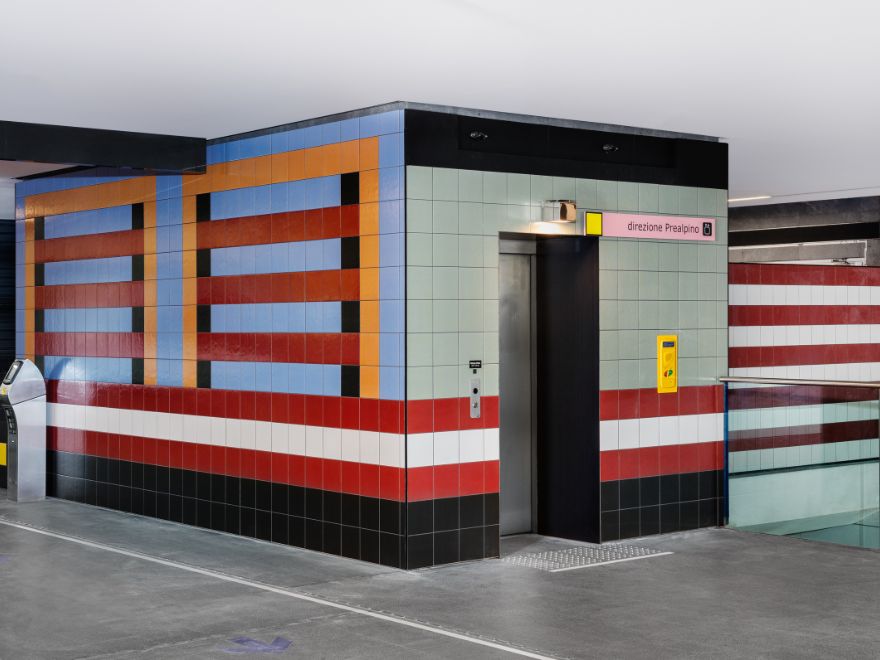
"Mind the gap", by Nathalie Du Pasquier, 2022, Victoria Metro Station
The French artist and designer, a pioneer of the Memphis design group in the 1980s and now a leading international figure, transforms ceramic tiles, typical of subways, into a distinctive element in Victoria Station. It invites visitors to look at and experience environments with a new perspective, suggesting a change of pace in daily life. The colourful Margherita tiles designed by Du Pasquier for Mutina cover the surfaces, creating a ceramic rainbow that is not only decorative, but also serves as a seat or tabletop. Ceramic, known for its durability and ease of cleaning in public places, becomes an artistic expression in Du Pasquier's hands, encouraging passengers to indulge in moments of pause and contemplation.
"BrixiaDue", by Andreas Angelidakis, 2024, Bresciadue Metro Station.
Greek artist-architect Andreas Angelidakis chose the Brescia subway to explore architecture as a place of social interaction, combining the ancient and the contemporary in a form of disorientation. Intervening in the station structure, he transformed the support struts and wall connections into four imposing Greek columns, offering an ironic journey through time. Inspired by the layering of time in the depths of the subway, Angelidakis shows ancient Brixia in the modern context. The columns, clad in rock wool and PVC, embody the concept of "soft ruins", representing the ever-changing nature of reality. Calling himself an "architect who does not build", Angelidakis deconstructs contemporary life using ancient architecture. The "soft ruins" series, with foam rubber and PVC columns, lies between digital and analogue space. As a traditional architect, Angelidakis has embraced virtual experiences, influencing his research in works such as BrixiaDue, where steel columns express nonlinear time and the continuous transformation of reality.
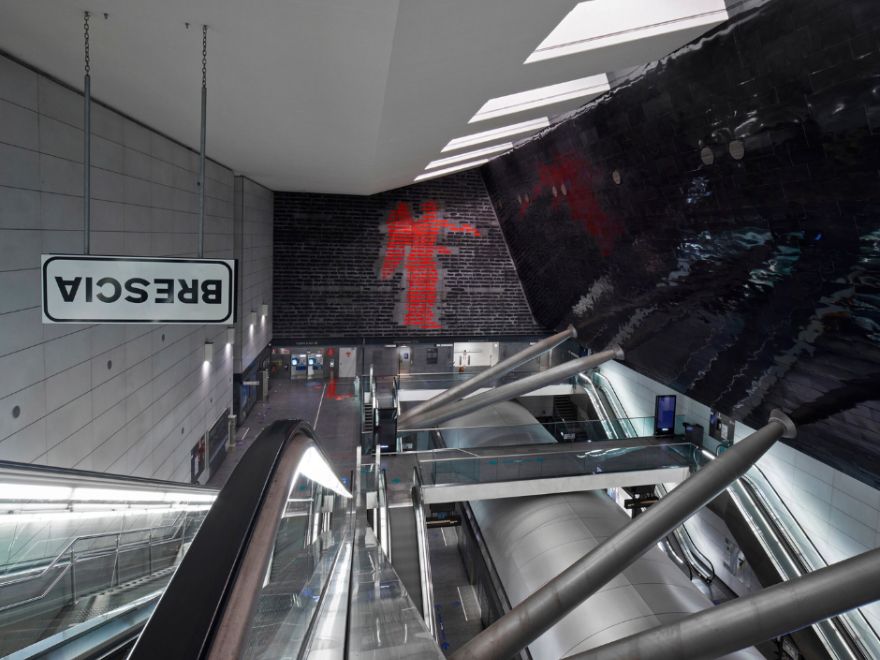
"Indelible Victory", by Emilio Isgrò, 2020, Metro Station FS
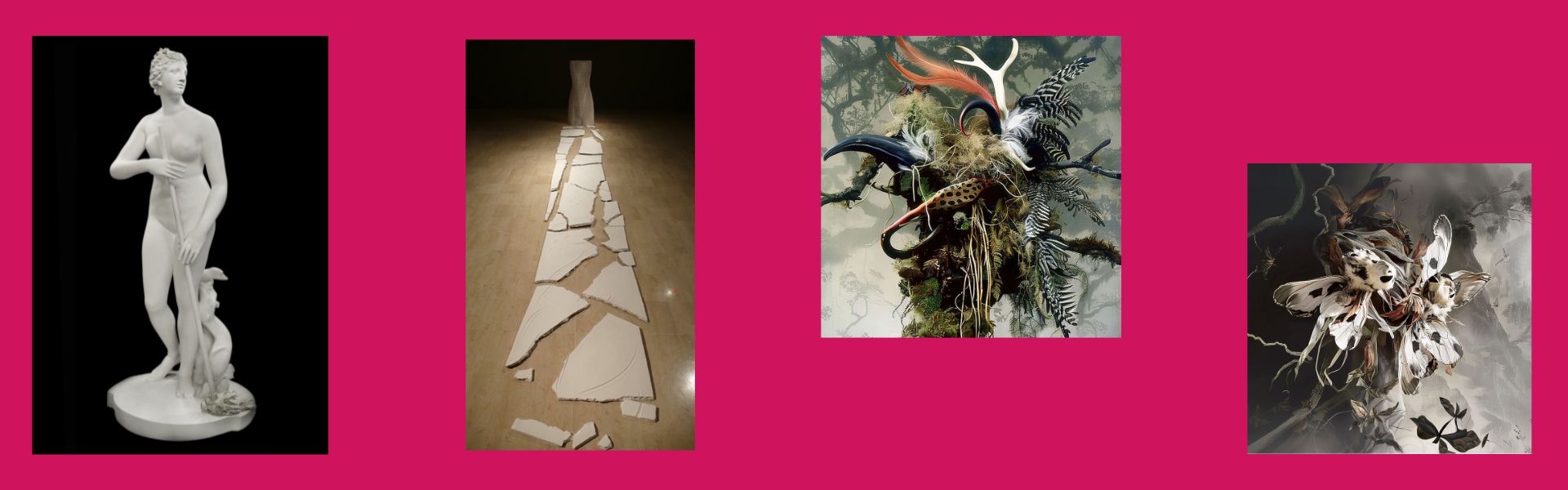
"Indelible Victory" by Emilio Isgrò is a monumental tribute to the Winged Victory statue, consisting of 205 fibre cement panels milled over an area of 200 square meters. The installation redraws the outline of the Roman goddess with erasures, characteristic of his expressive language.
The silhouette of the Roman goddess, sketched in red and recognizable by her wings and the raised position of her arms, emerges from a larger grid composed of black erasures on a passage from the Aeneid by Publius Virgilius Maro, a classical poet who probably frequented these areas because he was born in the Mantuan area, not far from Brescia, and the author of the literary masterpiece recounting the founding of Rome, its greatness and that of its empire of which Brixia (ancient Brescia) was one of the most important cities.
The project, donated to the city, represents a new symbolic and cultural gateway. The work, inspired by the layering of time and the figure of the Roman goddess, offers a message of strength and social unity in a complicated time like the pandemic one. Isgrò, linked to Brescia by a long-standing relationship, wanted to contribute to the city's rebirth through his art. Isgrò acknowledges Brescia's history, stressing that just as in the past the Winged Victory was a symbol of national unity, today the work is meant to inspire a courageous restart.
"The Stele", by Mimmo Paladino, 2017, Piazza della Vittoria
A human figure with stylized features, 6 meters high, made of Spanish Nero Marquina marble stands in the southwest corner of the Square. It is Mimmo Paladino's "The Stele", whose placement is divisive and ignites the long-running debate on the importance of resemantizing symbols of fascist memory in the city. The pedestal on which the stele stands is in fact a reconstruction of the one that housed the "Fascist Era", a statue placed in 1932 and praised by the Duce as a figurative synthesis of the Man of the 1920s. Today, and for the next 10 years, the pedestal is and will instead be occupied by the Stele of the great Transavantgarde master Mimmo Paladino: a work that assimilates the stylistic features of the 20th century avant-garde and transforms them into memory and warning.
An artistic work completed specifically for the Brixia Contemporary project of Fondazione Brescia Musei and the Municipality of Brescia, which featured international artist Mimmo Paladino as its 2017 protagonist.
"The Weight of Suspended Time", by Stephen Bombardieri, 2020, Piazza della Vittoria
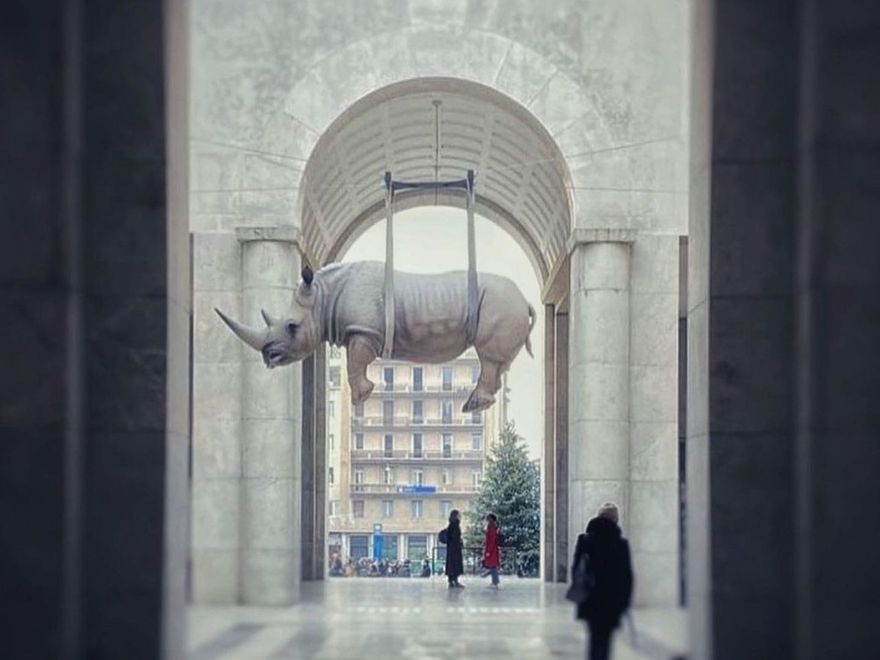
The suspended rhinoceros in the Quadriportico of Piazza Vittoria, part of Stefano Bombardieri's "The Weight of Suspended Time," is an emblematic and striking sculpture. Made of fiberglass, 4 meters long, hooked to converging rods, floating about 3 meters above the earth that temporarily does not belong to it, it represents a tangible weight reflecting moments of extreme joy or sorrow. The grey scale harmonizes with the surrounding marble, but also expresses the sense of bewilderment of the man-animal, who seeks anchorage in a world seemingly devoid of certainty.
Bombardieri's work, featuring towering animals, evokes questions about human reactions to events that challenge the precarious balance of life. It addresses themes such as time, perception, pain and the meaning of existence. The rhinoceros work, located in the historic centre, becomes a visual prototype and alter ego of the artist. Inspired by a sequence from Fellini's "And the Ship Sails On", Bombardieri created a work that reflects the human condition, particularly at a time marked by uncertainty related to the Covid emergency.
The suspended and stuck rhinoceros metaphorically represents the human condition of suspension and uncertainty; however, the artist emphasizes the readiness to touch the ground again, like the rhinoceros who, though stuck, is ready to put his feet back on the ground.
"The Light in the Pocket", by DMAV Art Collective (Dalla Maschera al Volto), 2023
The Pasquali - Agazzi Museum project includes three contemporary artworks created by the DMAV Art Collective, which illuminate urban spaces in honour of Rosa and Carolina Agazzi, influential pedagogues in the late 19th and early 20th centuries who contributed to the development of kindergarten education and pedagogy in Italy and abroad.
Contemporary artistic language is used to enhance the history of pedagogy, with graphic reworking by the DMAV Collective. The works, distributed in three significant places in the biography of the Agazzi sisters, create a poetic and physical journey. Each work summarizes key elements of their pedagogical thinking, focusing on the centrality of concrete and material "little things" in the educational process.
-
"Little Things to Grow Up", via Veronica Gambara, 3, Veronica Gambara High School, draws attention to concreteness, emphasizing the importance of unstructured material and "junk" that captures children's interest, essential to an educational journey.
-
"NaturaAnima", via Brigida Avogadro, Artigianelli Institute, near the place where the Agazzis lived. Neon plays with the alternating writing of Nature and Soul, two concepts totally intertwined in the Agazzi's pedagogy, in which Being in its entirety in contact with nature finds its highest expression.
-
The "IONOI" installation, via Ambaraga, at the back of the rectory of the Church of Santa Maria in Mompiano, where in 1895 Carolina first entered with 100 children in what represented the place where the Agazzi's pedagogy began to be consolidated. Neon reminds us that childhood is always the opening of a social space and the construction of a common world: a dimension in which the self and others, united in the interweaving of the we, give shape and meaning to reality.
"Stone and Tree", by Giuseppe Penone, 1976, viale Venezia
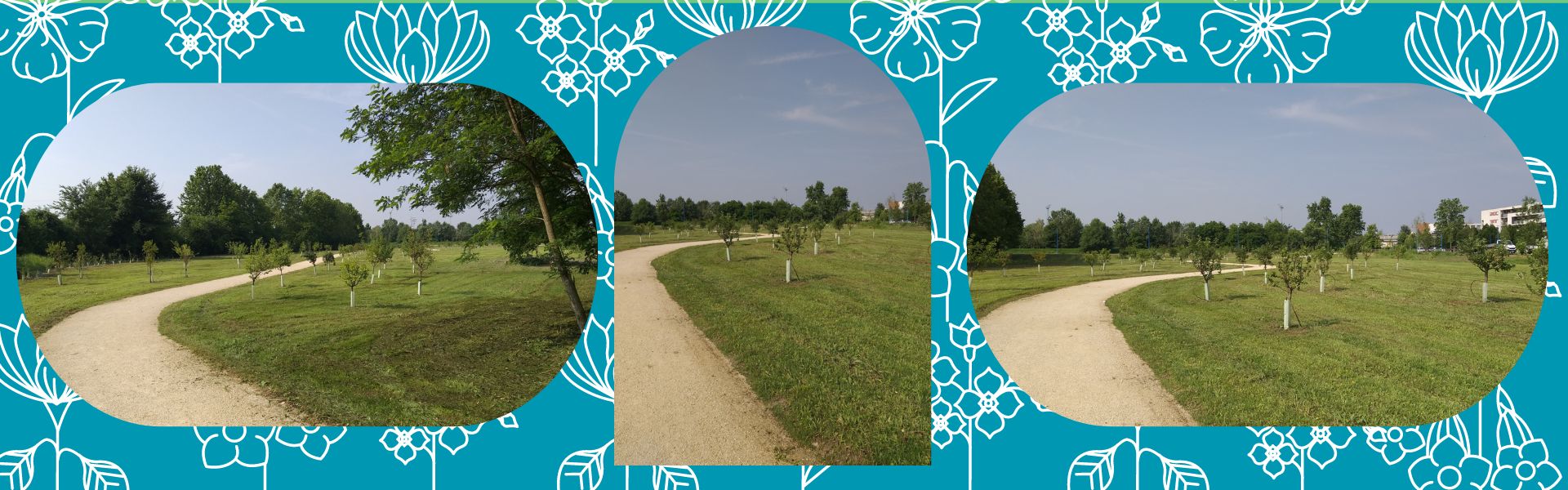
A remarkable example of Arte Povera, created by Penone for the "Art and Environment" exhibition, is installed in Rebuffone Park. The work combines a Botticino boulder with a horse chestnut tree, embodying the artist's poetic codes. The artist explores the combination of environmental change and human gestures, overlapping time and space, and reflects on the possibilities (and limits) of human action on nature.
The French term "aître" (derived from "atrium") phonetically recalls the infinitive of the verb "essere" (to be) and suggests an open place, a vacant lot, and the internal arrangement of a space. This word evolves into the meaning of consciousness and abyss of thought, overlaying the notion of physical space with that of being. Similarly, Penone, in his work, explores space in connection with being as bodily existence and perception through the senses.
Inside the garden, a Botticino boulder placed next to a horse chestnut tree shows grooves in the back that recall, in minimalist form, the columns of a Doric temple. Despite years of vandalism, the boulder now shows traces of blue colour.
The key to understanding the work is the observable metamorphosis between the boulder and the tree. In fifty years, the distance between them has narrowed, underscoring the passage of time in millimetres. Penone thus adds to being/aître and physical space also a third element, the temporal one, which will unite the two compositional elements the installation.
Penone thus emphasizes how the consequences of human actions can also emerge in the long term. If done with awareness, these actions can guide nature toward a gradual rapprochement with its ecosystem. The work becomes a marker not only of space, but also of time and, consequently, of existence.
(Text partially taken from Nicolò Fiammetti, in bresciaartguide.it)
"Floating Santa Giulia", by Fabrizio Plessi, 2021-2023
The work, created by Fabrizio Plessi as a site-specific installation for the exhibition PLESSI SPOSA BRIXIA, is now part of the Museum's permanent collections thanks to the artist's donation.
Placed next to the "Crucified Saint Julia", a 17th-century sculpture attributed to Giovanni Carra, the artist digitally reproduced the female figure through complex photogrammetry, focusing on the sculpted drapery as a speaking and changing form, symbolizing the flow of time and history.
The work is part of a complex multimedia work in which Plessi uses advanced technology to reinterpret classical sculptures and project them alongside the originals. Technology thus becomes an iconic activator, awakening visitors' distracted gazes on the artifacts and bringing to light what appears frozen and forgotten.
Focusing on the iconography of Saint Julia, Plessi states: "I want to give it life, make it move in the wind, as if it were still here", inviting reflection on the eternal message of history encapsulated in this historic and artistic asset. Enhancing the work with contemporary language, the artist explores themes such as the power of faith, the drama of sacrifice, and the ability of art to overcome the end of material things through its transcendental momentum.
Contemporary art in the Viridarium: the green spaces outside the domus, furnished with widespread tree species used in Roman times for ornamental, culinary or therapeutic purposes, house contemporary art installations that have been acquired over the years: Michelangelo Pistoletto's Third Paradise (2015), Ariel Schlesinger's We started with a Flame (2019), Valerio Rocco Orlando's We Form Humanity (Industrious Lives) (2023), and Emilio Isgrò's World of Steel (2023).
"The Third Paradise", by Michelangelo Pistoletto, 2015
The term "paradise", from ancient Persian, means "protected garden". Human history has known two paradises: the first, governed entirely by nature; the second, an artificial paradise forged by human intelligence over the centuries, bringing improvements to human life but also conflicts with the natural world. Michelangelo Pistoletto conceives of the Third Paradise as a quest to reconcile opposing polarities, such as nature and artifice, achievable only through collective social responsibility.
Pistoletto's installation connects ancient stone artifacts on the ground with thin aluminum sheets on the wall, creating a symbolic dialogue between the art of the past (represented by Roman stones) and that of the present (symbolized by stainless steel). The first circle evokes the paradise in which humanity was integrated with nature, while the second circle represents the artificial paradise, the result of human intelligence with artificial needs, products and pleasures.
The Third Paradise, in the centre, symbolizes the conjunction of the previous two, proposing a new stage of planetary civilization in which nature and artifice coexist in balance. This condition is crucial to ensuring human survival, outlining a vision of harmony and balance between the two forces.
"We Started with a Flame", by Ariel Schlesinger, 2019, Courtesy Massimo Minini Gallery
In the Viridarium garden there is a 7-meter-long bronze tree by Israeli contemporary artist Ariel Schlesinger. It is a cast of a large persimmon tree with arthritic branches made of bronze. It is titled We started with a Flame. Schlesinger wants this tree, which he imagines survived a destructive event, to represent the force of nature that burns but never consumes. In fact, among the tons of matter, a tiny, inexhaustible flame burns that cannot scratch the bark.
The work combines constant research into the transformation of an event from a negative into a positive one, the exploitation of something ordinary as a creative possibility, an unprecedented desire for confrontation with large sculpture that never loses sight of the value of surprise.
"We form humanity", by Valerio Rocco Orlando, 2022
"We Form Humanity" is a light sculpture belonging to Valerio Rocco Orlando's art project "Industrious Lives", hosted in the province of Brescia. The region stands out for its multiculturalism and inclusiveness toward new citizens, especially through employment. Initiated in 2012 by the Brescia Musei Foundation in collaboration with the Friends of FAI and Art Association, the project aims to integrate new residents through knowledge of local artistic heritage.
Starting with training courses for artistic-cultural mediators, the project involved Italian and foreign citizens, promoting integration and intercultural dialogue. Valerio Rocco Orlando worked with this group to explore the forms of social participation resulting from the enhancement of cultural heritage and the role of work in social integration.
The dialogue led to a creative workshop in which each participant came up with meaningful sentences. Orlando selected the most emblematic one, "WE FORM HUMANITY," and turned it into a neon light sculpture, handcrafted in a unique edition. This work, part of a cycle that includes installations on the tower of the Berlucchi Castle in Borgonato and in the courtyard of GAMeC in Bergamo, embodies the role of art as a universal language that facilitates dialogue between different cultures, promoting the formation of a shared humanity through art.
"World of Steel", by Emilio Isgrò, 2024
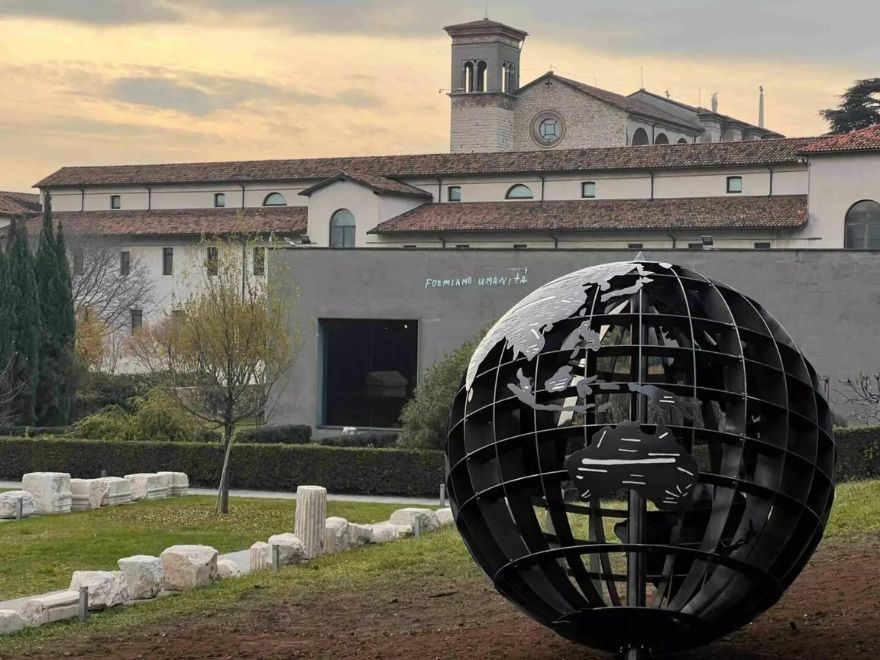
Emilio Isgrò's work concludes the artistic journey that began with the temporary installations Isgrò cancels Brixia in the format "Archaeological Stages". This work, placed in the Viridarium – Parco delle Sculture di Santa Giulia, represents a massive steel globe with a diameter of 4 meters. Emerging from the lawn into the north-facing green ridge, the "Steel World" dialogues in a balanced way with the surrounding monumental space.
The globe, similar to a ball pinned to the ground by the earth's axis, has opaque land surfaces. Emilio Isgrò uses his distinctive erasing technique to cover city names on solid steel meridians and parallels, leaving only Brescia, called by its Latin name, Brixia, in evidence. This symbolic gesture indicates that only this city can resist the oblivion of erasure, representing the strength of its Roman roots and its ability to survive in history.
The master, who has been deeply involved in the enhancement of Brescia's archaeological heritage since 1957, questions the determination of origins in history and claims Brescia's fundamental role in this context. Isgrò's work gives the city an autonomous and recognizable history, acknowledging the way Brescia has protected its past while maintaining a constant dialogue with the contemporary. Brixia's deep connection to Romanity is celebrated as an outstanding cultural and civic community, reflecting its UNESCO heritage status in a historic archaeological space.
"Chimpanzee", by Davide Rivalta, 2023
Rivalta's animalier sculptures, created especially for Brescia Castle for the exhibition Dreams of Glory, reproduce animals, encountered and photographed in parks and zoos: bodies in captivity, uprooted from their natural environment, to which Rivalta restores dignity and life in a new context. The sculptures configure the image of a new world, in which the man-made landscape, the Castle Park, among other places the site of a zoological garden until 1988, becomes the territory of the animal, a kind of anthropomorphic ape kingdom.
The group of chimpanzees that remained after the conclusion of the exhibition placidly occupies the Martyrs' Pit in the north area of the Visconti keep.
These primates take over space, but they sometimes express an intention to invade new ones, a desire to conquer and extend their dominance over the place. The title of the exhibition, Dreams of Glory, referred precisely to this impulse suggested by the postures of the animals and their hypothetical movements and trajectories, through which the real space also becomes the energy field of the sculpture.
"Hunted from Paradise", by Joseph Bergomi, 2023
Giuseppe Bergomi's work stands as a memorial to the victims of Covid-19 along the main avenue of the Vantiniano Cemetery. This work, conceived and created by renowned Brescian artist Giuseppe Bergomi, ranks among the most relevant creations on the subject in the international art scene.
The artist moulded six female and as many male figures in black bronze, portraying them with bowed heads, naked and vulnerable, in order to represent the inherent loneliness of humanity in the face of adversity, especially in the face of the devastating force of the pandemic and other unforeseen events that bring suffering and mourning.
In the central core of the composition, two figures emerge with a cry of pain, calling to mind the iconography of the "Expulsion of Adam and Eve from Eden" painted by Masaccio in the Brancacci Chapel fresco inside the church of Santa Maria del Carmine in Florence. This iconographic choice gives the work a symbolic intensity that underscores the tragic fate shared by the victims of the virus and their lacerating separation from their original harmony.